OUR PROTOCOL
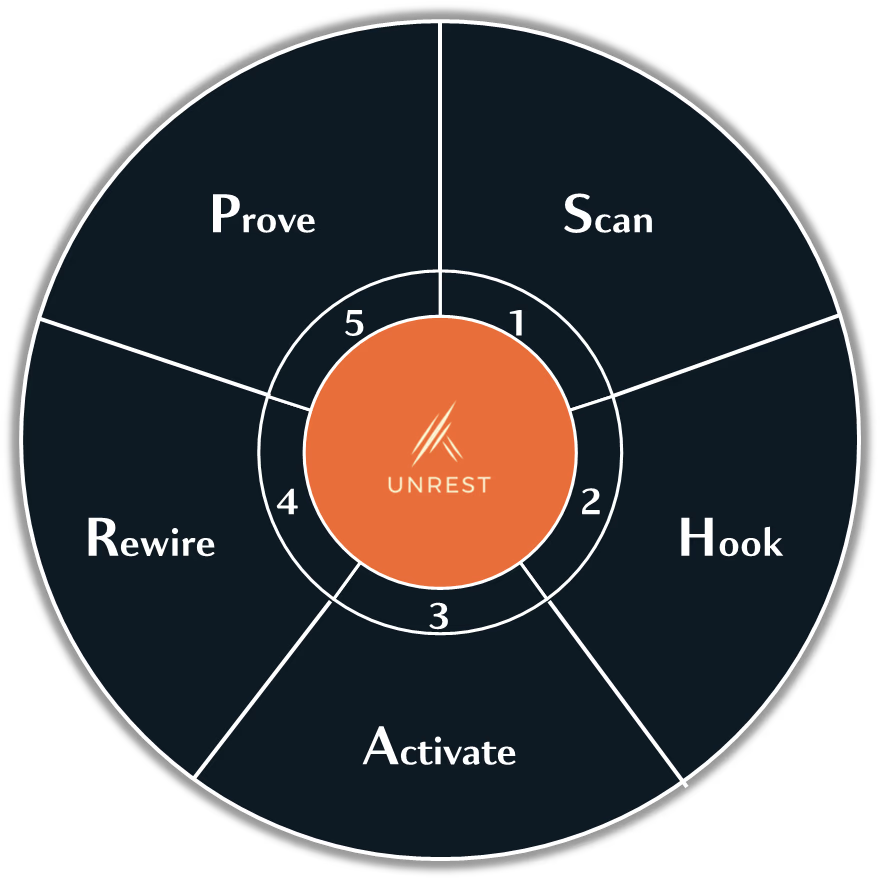
SPARK® is our intervention protocol, based on behavioral science and organizational psychology.
Sequential and pragmatic, it structures each of our interventions, whether individual or collective.

Grounding Change Management in Rigorous Behavioral Evidence.
Most change management approaches rely on buy-in: explaining, convincing, training, and then measuring project acceptance. This gamble is based on an assumption that research has largely nuanced.
Transformation takes shape in daily decisions and actions. Understanding the project and wanting it to succeed are important, but employees also need the means to act. Conflicting objectives or poorly adapted tools complicate the implementation of expected practices.
A meta-analysis by Webb and Sheeran (2006) shows that interventions that strengthen intentions achieve, on average, a more limited evolution in behavior. SPARK examines this transition to action based on work situations: who needs to do what differently, when, and under what conditions?
Observable behavior is its unit of work. The diagnosis looks for what facilitates or hinders it, including within the organization's rules and decisions. It also explores readiness for change: the reasons to contribute, the reservations, and the conditions necessary to try new practices.
A structured protocol based on the latest research
SPARK® integrates, into a single intervention cycle, the reference models in international research on behavioral change and organizational development. It notably orchestrates:
• The COM-B model and the Behaviour Change Wheel, mobilized by the Centre for Behaviour Change at University College London, to understand capabilities, opportunities, and motivations, and then identify relevant intervention functions.
• The BCTTv1 taxonomy, to precisely describe the behavioral techniques selected, such as demonstration, training, or feedback.
• The OECD's BASIC framework, to structure experimentation work and deployment decisions, with attention to maintenance conditions and ethics.
Standardized tools, measurable outcomes
Every intervention is based on explicit protocols, published frameworks, and validated psychometric instruments.
Target behaviors are specified in a standardized way, their determinants are diagnosed using proven grids, and action techniques are named according to a taxonomy shared by the scientific community.
Every choice is documented and traceable in a tracking matrix, from the initial diagnosis to the impact assessment. The process can thus be explained, replicated from one team to another, and verified with complete transparency by the client themselves.
A structured, repeatable and results-oriented methodology.
SPECIFY
- Behavior specification: Translating business ambitions into precise, observable target actions.
- Determinant diagnostic: Comprehensive analysis of factors that facilitate or hinder action (capabilities, environmental opportunities, motivations).
- Baseline measurement: Ex-ante assessment of change load and organizational fatigue.
DIAGNOSE
- Shared feedback: Transparently laying out field-level obstacles to align expectations between management and teams.
- Portfolio arbitration: Explicit decision-making on which projects to launch, maintain, or scale back to preserve absorption capacity.
- Contractualization: Clarifying the mandate, authority, roles (BART), and resources allocated to each stakeholder.
DESIGN
- Intervention design: Simplifying workflows and adjusting choice architecture directly at the point of work.
- APEASE filtering: Strict selection of solutions based on acceptability, practicability, and effectiveness.
- Pilot experimentation: Small-scale testing with one team to refine the solution based on field feedback.
DEPLOY
- Wave-based deployment: Selected interventions are rolled out at a pace compatible with team workloads.
- Systemic anchoring: Processes, tools, and decision-making rights are adjusted so that the new practice becomes a standard part of daily operations.
- Transfer: Managers and internal leads are equipped to maintain these practices without our involvement.
SUSTAIN
- Impact measurement: Ex-post evaluation of indicators and comparison of observed behaviors against the ex-ante assessment.
- Process evaluation: Rigorous distinction between the value of the intervention and the quality of its field implementation.
- Contribution analysis: Qualifying the level of evidence to document achievements and inform the next cycle.
An explicit intervention logic, from goal to evidence
Our protocol follows an explicit causal logic, with hypotheses put to the test. We start from the expected result, translate it into observable behaviors, and then trace back to what enables or prevents them, both in the individuals and in their work environment. The intervention targets these conditions, integrates into daily operations, and its effects are measured against the initial state.
Business goal
Observable behaviors
Determinants
Intervention
Anchoring
Evidence
Behavioral Science Applied to Organizational Change
UNREST draws on applied behavioral science, organizational psychology, and organizational development: disciplines pioneered and refined primarily in the US and the UK. We leverage their methodologies to pinpoint friction points, design interventions tailored to real-world work, and measure their tangible impact.

We leverage peer-reviewed, evidence-based frameworks and instruments to measure the exact human factors that dictate transformation success or failure. The goal: bring clarity to your strategic decision-making.


Mastering Change through Cognitive & Behavioral Skills
higher probability
of workplace well-being
Global Leadership Forecast
Preparing Organizations for an Uncertain World
In a radically uncertain world, the performance of an organization depends on its adaptability. UNREST is the first change enablement advisory firm designed to develop this behavioral and relational competence.