
.svg)
OUR FRAMEWORK: S.H.A.R.P.®
S.H.A.R.P.® is the first integrative Change Enablement framework. Objective: develop the behavioral skills that make change desirable and sustainable.
Jean Piaget
The First Framework for Cognitive and Behavioral Change
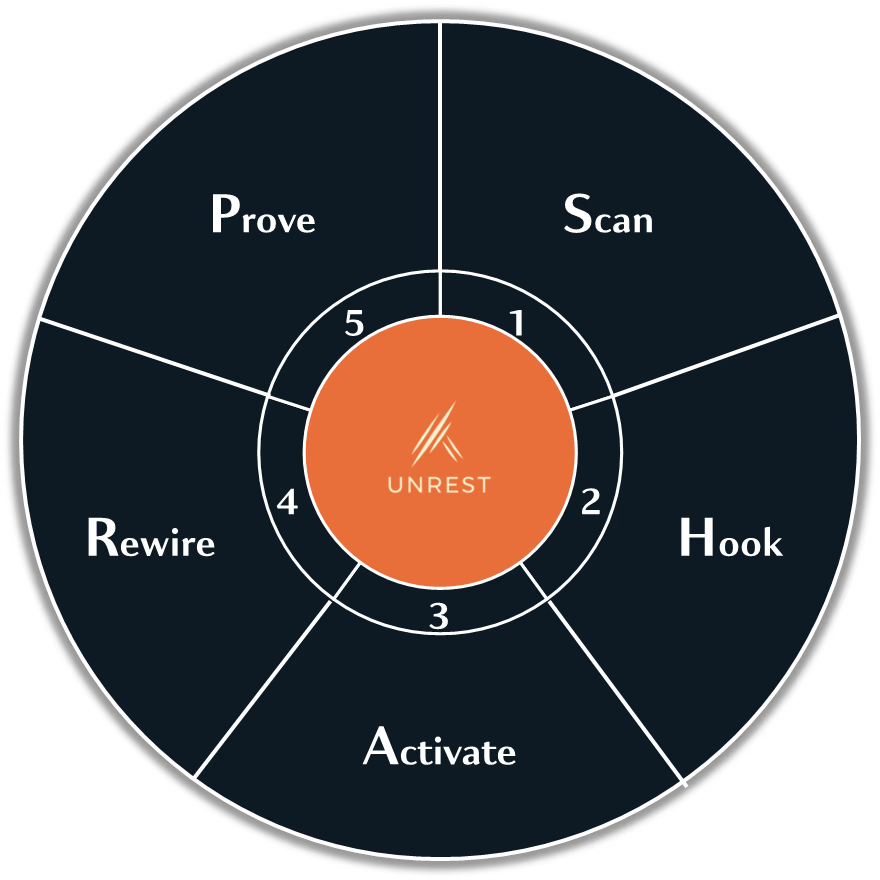
S.H.A.R.P.® is a change management framework at the intersection of consulting and behavioral sciences.
We developed this proprietary model of Change Enablement as the first integrative framework of change cognitive-behavioral enabler. We don't “manage” change. We develop the ability to change. Scientific, sequential and operational, this model guides individuals towards autonomy by combining accurate diagnosis, field experimentation and impact measurement.
A scientific and operational architecture
The S.H.A.R.P.® model is explicitly in line with the major scientific models of behavioral change, of which it offers an operational translation rooted in the real world of work:
- ADKAR : For the sequential logic of individual change (meaning → commitment → capacity → reinforcement).
- TTM (Transtheoretical Model) : To assess the real willingness to change before any intervention.
- COM-B : To understand the causal structure of behavior (abilities, opportunities, motivation)
- 4T (Target, Theory, Timely, Test) : To target a specific behavior, formulate an explicit hypothesis and measure the effect obtained
We have articulated a coherent architecture, focused on the development of behavioral skills in real situations.
A scientific and operational architectureBy going from an incantatory pilot to a real behavioral engineering, we transform the perception of change within the organization:
- Objectivity: The human conditions for change are measured, making transformations controllable by data.
- Pragmatism : Blockages are no longer morally interpreted, but identified as needs for capacities or opportunities to be addressed.
- Autonomy : Managers develop the psychosocial skills of their teams, reducing dependence on external experts.
Change thus ceases to be a project to be managed to become a skill to be managed.
A structured, repeatable and results-oriented methodology.
Model the conditions of change.
- Demand analysis : Rigorous validation of the business purpose.
- Assessment of the layout : Measuring readiness for change.
- Skills audit : Assessment of current behavioral skills.
- Systemic diagnosis: Identification of organizational constraints.
- Strategic framework : Selection of the most relevant intervention system.
Validate the real desire to engage in change.
- URICA diagnosis : Use of the URICA tool to precisely qualify the willingness to change.
- Motivational adjustment : Adaptation of the intervention according to the maturity identified to avoid launching an action plan prematurely.
- Acculturation : Awareness-raising and psychoeducation actions to align representations.
Designing the targeted business and behavioral objective.
- Causal hypothesis : Establishment of an explicit link between the targeted behavior and the expected business impact.
- SMART planning: Construction and prioritization of actions according to measurable and realistic criteria.
- Self-agreement test : Validation of the plan to ensure that it resonates with the intrinsic motivations of the actors.
- Behavioral specification : Precise and rigorous definition of expected observable behaviors.
Experiment with new patterns in real conditions.
- Specialized coaching : Cognitive and behavioral support at the individual, team or organizational level.
- Educational engineering : Devices of Development & learning anchored in the workflow.
- Cultural evolution: Management of cultural transformation for collective devices.
Anchor new automations and avoid a return to old habits.
- Impact measurement : Quantitative and qualitative evaluation of the results obtained in relation to the initial objectives.
- Anchoring achievements : Establishment of consolidation mechanisms to ensure the sustainability of new behaviors.
- Sustainability analysis : Verification that the change is maintained over time without exhausting resources.
Tailor-made interventions, based on structured instruments.
These levers are integrated into our protocol in order to ensure continuity between diagnosis, development and performance, while allowing fine adaptation to individual, collective and organizational challenges.
Psychometric diagnoses of cognitive, behavioral and relational skills
We objectify the behavioral skills and cognitive patterns mobilized in real situations of decision and change, at the individual or collective level.
These diagnoses provide a ex-ante evaluation, making it possible to precisely identify individual and collective goals and levers for progress, beyond feelings or self-perception.
Behavioral and cultural transformation
Following the diagnoses carried out initially, we analyze the real organizational constraints (structures, processes, modes of governance, cognitive load) that condition behaviors.
This lever makes it possible to align transformation ambitions with effective cognitive and relational abilities of the system.
We then design with you the systemic intervention device the most suitable for sustainably transforming behaviors within your organization and serving your performance and health goals at work.
Cognitive and behavioral coaching
Based on an individual and collective diagnosis, we support leaders in the development of their behavioral and relational skills.
The cognitive-behavioral coaching aims to strengthen the quality of judgment and collaboration of decision-makers, by working on the thought patterns, biases and emotional regulations that influence managerial action. Objective: unleash the power to act by allowing individuals to identify and correct their counterproductive patterns.
Development & learning
We are developing a shared behavioral and relational culture within teams, based on the understanding of biases, stress mechanisms, stress mechanisms, cognitive load and relational dynamics mobilized in real work.
This lever makes it possible to install a common language and shared reference points to support the adjustment of behaviors and the sustainability of the transformations undertaken.
Cognitive-behavioral digital twin
Our cognitive-behavioral digital twin extends our support over time, by relying on The subjective experience of real work and the concrete situations encountered by decision-makers and teams.
This lever allows continuous monitoring of cognitive and behavioral dynamics, through a mirror effect, contextualized nudges and active memory of real work, in order to support the adjustment of decisions and the lasting anchoring of transformations.
Cognitive-Behavioral Reverse Engineering of Change.
Our intervention protocol is based on an explicit causal chain, aiming to trace the expected behavioral result back to the cognitive mechanisms that produce it.
Behavioral Purpose
Operational Goals
Behavioral Skills
Cognitive Patterns
Mastering Change through Cognitive & Behavioral Skills
Talents who regularly develop these skills statistically have:
more likely to excel in their roles
Source: Global Leadership Forecast, DDI, 2025.
Why Call on Us?
We make change your comparative advantage and a source of development for your talents.
We only use research instruments
Our support method is structured and standardized
The impact of our interventions is traceable and measurable
Preparing Organizations for an Uncertain World
In a radically uncertain world, the performance of an organization depends on its adaptability. UNREST is the first change enablement advisory firm designed to develop this behavioral and relational competence.